


When people visit a Nadi Astrology centre, they often want answers to questions about marriage, career, family, finances or other important areas of life. During a reading, they may also hear about something called Pariharam.
This can raise a few questions. What does Pariharam mean? Why are remedies suggested during a Nadi reading? And how are these remedies connected to the different Kandams?
To understand this, it helps to know how Nadi Astrology is traditionally organised and what each chapter is meant to cover.
What Are Kandams in Nadi Astrology?
In traditional Nadi Astrology, the chapters of a palm-leaf reading are known as Kandams. Each Kandam focuses on a particular area of life or provides a different type of information.
For example, someone looking for guidance about marriage may be interested in Kalyana Kandam, while a person asking about career or business may explore Karma Kandam.
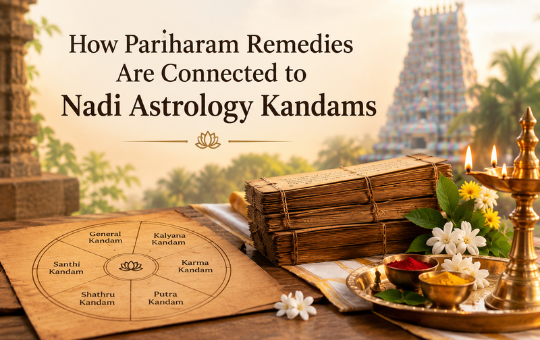
Some of the commonly described Kandams include:
- General Kandam: Provides an overall account of a person’s life according to the tradition.
- Kalyana Kandam: Focuses on marriage and relationships.
- Karma Kandam: Relates to career, employment and business.
- Putra Kandam: Covers matters connected with children.
- Shathru Kandam: Deals with topics such as debts, disputes and difficulties.
- Santhi Kandam: Specifically associated with Pariharam and traditional spiritual remedies.
The information available can depend on the relevant palm leaf and the reading being followed. Not every person will necessarily explore every Kandam.
What Is Pariharam in Nadi Astrology?
Pariharam refers to a traditional spiritual or religious remedy. In Nadi Astrology, it may be suggested when a reading describes certain challenges or influences that, according to the tradition, require spiritual attention.
These remedies may involve temple visits, pooja, mantra chanting, charity, homam or other devotional practices.
The purpose of Pariharam is understood through traditional beliefs about karma and spiritual practice. For many believers, it offers a way to respond to difficult situations through prayer, devotion and positive actions.
It is important to remember that these are traditional spiritual beliefs. A remedy should not be treated as a guaranteed solution to every problem.
How Are Kandams and Pariharam Connected?
The connection becomes clearer when you understand the role of Santhi Kandam.
Other Kandams discuss different aspects of a person’s life, such as marriage, career, family or financial concerns. During a traditional Nadi reading, the information in these chapters may help explain the area of life about which a person is seeking guidance.
Santhi Kandam, meanwhile, is specifically associated with Pariharam. It describes traditional rituals believed to help address the effects attributed to past deeds.
In simple terms, the reading provides information about a particular area of life, while Pariharam may offer a spiritual practice connected with the guidance given.
However, this does not mean that every challenge mentioned in every Kandam automatically requires a remedy. Whether Pariharam is discussed depends on the reading and the tradition followed by the practitioner.
What Types of Remedies May Be Suggested?
The remedies suggested during a Nadi Astrology consultation can differ from person to person. Depending on the reading and the tradition, they may include:
1. Temple visits and prayers
A person may be advised to visit a particular temple and offer prayers. For many devotees, this provides an opportunity to practise faith and spend time in reflection.
2. Pooja and traditional rituals
Certain forms of worship may be suggested as part of the Pariharam. The ritual and its purpose should be explained clearly before it is performed.
3. Mantra chanting
Some traditional practices involve chanting specific mantras as part of daily prayer or spiritual discipline.
4. Charity and helping others
Giving food, donating useful items or supporting people in need may be recommended in some traditions. These acts can also encourage kindness and a sense of social responsibility.
5. Homam and other devotional practices
Depending on the guidance provided, a traditional fire ritual or another form of worship may be suggested.
These practices are not interchangeable, and there is no single remedy that applies to everyone.
Is Pariharam the Same for Every Kandam?
No. Kandams cover different subjects, and the guidance provided during a reading can vary according to the person’s questions and the information found in the relevant palm leaf.
For example, someone exploring career matters through Karma Kandam may receive different guidance from someone seeking information about marriage through Kalyana Kandam.
If Pariharam is indicated as part of the traditional reading, Santhi Kandam is the chapter specifically associated with such remedies.
Rather than assuming that a particular ritual is necessary, it is better to ask the Nadi reader to explain why it has been suggested and how it relates to the reading.
Understanding Pariharam With the Right Perspective
Nadi Astrology is a traditional spiritual practice, and people approach it for different reasons. Some are curious about their life path, while others seek guidance during a difficult period.
Pariharam forms one part of this tradition. For those who believe in it, prayer, temple worship and charitable acts can provide spiritual comfort and a sense of purpose. However, no ritual can be guaranteed to resolve a particular life problem, and practical decisions remain important.
At Sri Agasthiya Maha Siva Nadi Astrology in Vaitheeswaran Koil, Guruji Vikramathithan offers traditional Nadi Astrology consultations to help people understand their readings and the guidance associated with them. Online consultations are also available for those who cannot visit in person.
If you are curious about Nadi Astrology Kandams and Pariharam, learning how they are traditionally connected can help you approach a reading with a clearer understanding.
To learn more about your Nadi reading, visit Sri Mahasivanady.com.