
loading

Tag: nadi astrology services

  • Home
  • Tag: nadi astrology services

Why Are Remedies Suggested in Nadi Astrology for Different Life Problems?

When people hear about Nadi Astrology remedies, one question often comes up: Why are remedies suggested for different problems in life?

Someone may visit a Nadi astrologer with questions about marriage, career, business, family, finances or children. During the reading, the astrologer may explain certain challenges and suggest a traditional remedy, commonly known as Pariharam.

For someone experiencing Nadi Astrology for the first time, this can seem confusing. Why is a remedy needed? Is the remedy the same for everyone? And what is the connection between Pariharam and a palm leaf reading?

Let us understand it in simple terms.

What Is Pariharam in Nadi Astrology?

In the traditional Nadi Astrology system, Pariharam refers to spiritual or religious remedies suggested in connection with difficulties described in a person’s reading.

According to this tradition, some challenges are understood through the idea of karma or the effects of past actions. When such influences are mentioned during a Nadi reading, a practitioner may suggest certain spiritual practices as Pariharam.

These may include temple visits, prayers, pooja, mantra chanting, charity, homams or other traditional practices.

At Sri Agasthiya Maha Siva Nadi Astrology, Santhi Kandam is specifically associated with Pariharam and traditional rituals intended to reduce the effects attributed to past deeds.

Why Are Different Remedies Suggested for Different Problems?

One important thing to understand is that Nadi Astrology remedies are not necessarily the same for everyone.

A person asking about marriage may receive different guidance from someone asking about career or family matters. This is because traditional Nadi readings are divided into different Kandams, or chapters, covering various areas of life.

For example, Kalyana Kandam relates to marriage, Karma Kandam covers career and business, Putra Kandam relates to children, and Shathru Kandam deals with areas such as debts, disputes and other difficulties. The traditional system also includes Santhi Kandam for Pariharam.

So, the remedy suggested during a Nadi reading is traditionally connected to the particular issue or circumstances discussed in the reading.

What Types of Nadi Astrology Remedies Are Suggested?

There is no single remedy that applies to every person.

Depending on the reading and the tradition followed by the practitioner, Nadi Jothidam remedies may include:

  • Visiting a particular temple
  • Performing a pooja
  • Chanting specific mantras
  • Participating in a homam
  • Offering prayers
  • Giving charity or helping people in need
  • Following certain spiritual practices
  • Visiting a temple connected with the suggested Pariharam

The purpose and method can vary from one reading to another.

The important point is to understand why a remedy has been suggested and how it should be performed, rather than simply following a remedy without understanding it.

How Are Remedies Connected to a Nadi Reading?

Traditional palm leaf astrology is based on the belief that information about a person’s life is recorded in palm-leaf manuscripts.

During a Nadi reading, the practitioner identifies and reads the relevant leaf and explains information relating to different stages and areas of life. Traditional Nadi sources may also include guidance about remedies for difficulties mentioned in the reading.

This is why Pariharam is often discussed as part of the reading rather than as a completely separate service.

The reading may describe a challenge, while the traditional remedy provides a spiritual practice that the person can choose to follow.

Does Pariharam Guarantee That a Problem Will Be Solved?

It is important to look at this realistically.

Pariharam should not be understood as a guaranteed solution to every problem. The idea of spiritual remedies comes from the traditional beliefs and practices associated with Nadi Astrology.

For believers, these practices may provide spiritual comfort, discipline and a sense of direction. Visiting a temple, praying, chanting a mantra or helping someone through charity can also encourage reflection and positive action.

At the same time, practical problems still require practical decisions.

For example, someone facing a career challenge may benefit from spiritual guidance while also improving their skills, applying for suitable opportunities and making careful career decisions. Similarly, financial concerns require responsible planning, regardless of whether someone chooses to follow a traditional remedy.

Sri Mahasiva Nadi’s own content describes Pariharam as traditional spiritual guidance and recommends that remedies be explained clearly rather than creating unnecessary fear or pressure.

Why Do People Choose Nadi Astrology Remedies?

For many people, the appeal of Nadi Astrology Pariharam is that it gives them something meaningful to do when they are going through a difficult period.

Instead of simply hearing a prediction about a challenge, they may receive a traditional spiritual practice that gives them a sense of purpose.

For some, it may be visiting a temple. For another person, it could be prayer, charity or a particular pooja.

The experience can be deeply personal, and people’s beliefs and experiences can differ.

What Should You Ask Before Following a Remedy?

If a Pariharam is suggested during your Nadi reading, it is reasonable to ask a few simple questions:

  • Why is this remedy being suggested?
  • What is the traditional purpose of the remedy?
  • How should it be performed?
  • Is it necessary to perform it at a particular temple?
  • Can it be performed locally if travelling is difficult?
  • Are there any specific steps you need to follow?

A good Nadi Astrology consultation should explain the suggested remedy clearly so that you understand what you are being asked to do.

Final Thoughts

Nadi Astrology remedies are traditionally suggested as a spiritual response to challenges identified during a Nadi reading. They may involve temple visits, prayers, pooja, mantra chanting, charity or other forms of Pariharam.

The reason a particular remedy is suggested depends on the traditional interpretation of the individual’s reading and the area of life being discussed.

Whether you follow a remedy is ultimately a personal decision. It is always helpful to understand the purpose behind the practice, approach it without fear, and continue taking practical steps in your everyday life.

For people exploring Vaitheeswaran Koil Nadi Astrology, Pariharam is considered an important part of the traditional reading process. At Sri Agasthiya Maha Siva Nadi Astrology, Guruji Vikramathithan provides guidance on traditional remedies when they are indicated during the consultation, including online consultations for people who cannot travel to Vaitheeswaran Koil.
The History of Palm Leaf Reading: From Ancient Manuscripts to Modern Nadi Astrology

Long before people searched for answers on the internet, they looked for guidance in very different ways.

Across India, knowledge was passed from one generation to another through teachers, stories, temples and handwritten manuscripts. Among the most fascinating of these traditions is palm leaf reading, a practice that has become closely associated with Nadi Astrology in Tamil Nadu.

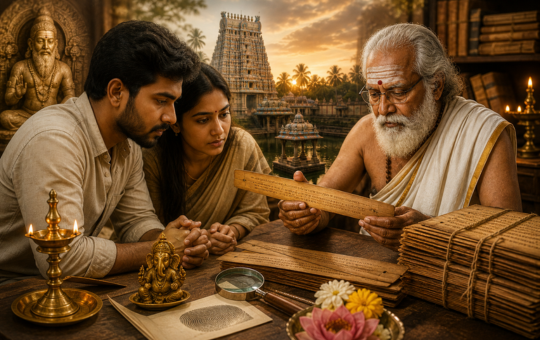
Even today, people travel to Vaitheeswaran Koil to experience a tradition involving old palm-leaf manuscripts, thumb impressions and Nadi readings.

But where did this tradition come from? And how did something written on fragile leaves centuries ago become part of modern astrology?

Let’s take a closer look.

What Is Palm Leaf Reading?

Palm leaf reading refers to the traditional practice of interpreting information recorded on prepared palm leaves.

In Tamil, these manuscripts are commonly known as Olai Chuvadi. Palm leaves were used as a writing material in different parts of India for preserving religious works, literature, medicine, philosophy, astronomy, astrology and other forms of traditional knowledge. The Government of India also recognises palm-leaf manuscripts as an important part of the country’s manuscript heritage.

The leaves were carefully prepared, dried and cut into long, narrow pieces. Writing was then engraved into the surface using a pointed instrument.

This is one reason ancient palm-leaf manuscripts look so different from modern books.

They were not designed to last forever. Palm leaves are naturally vulnerable to moisture, insects, heat and repeated handling. Preserving them required care, and many manuscripts had to be copied from older leaves over time.

The Traditional Story Behind Nadi Astrology

The history of Nadi Astrology has another layer — the spiritual tradition surrounding the manuscripts.

According to traditional Nadi accounts, ancient sages and Siddhars had deep spiritual knowledge through which they were believed to perceive the lives and experiences of people who would seek their guidance in the future.

Sage Agasthiyar, or Agastya Maharishi, is one of the names most strongly connected with this tradition.

The belief is that these sages recorded their insights on palm leaves so that the appropriate person could find the information at the right time.

This is a spiritual belief rather than something that can be established as a conventional historical timeline. That distinction is important.

What we can clearly see is that palm-leaf manuscripts have a long history in South Asian knowledge traditions, while Nadi Astrology developed as a living practice around the interpretation of particular manuscripts.

That combination of history, spirituality and tradition is what makes Nadi reading so intriguing.

How Were the Palm Leaves Written?

Writing on a palm leaf was a skilled process.

A prepared leaf was made smooth enough to receive writing, and a sharp stylus was traditionally used to make fine incisions in the surface. The letters were then made more visible so that the writing could be read.

The result was a long, narrow manuscript with rows of carefully engraved characters.

Imagine doing this without a printing press, computer or even ordinary paper.

Every line had to be created by hand.

Over time, these manuscripts could become worn, which is why traditional manuscript preservation has always been important. Across India, institutions and scholars continue to work on conserving, cataloguing and digitising palm-leaf manuscripts.

From Palm Leaf Manuscripts to Nadi Reading

Not every palm-leaf manuscript is a Nadi manuscript.

This is something that is often misunderstood.

Palm leaves were used for many kinds of knowledge. Nadi Astrology is one particular tradition associated with astrological and spiritual readings.

In traditional Nadi practice, the manuscripts are organised and interpreted through methods passed down among practitioners.

One of the most interesting parts of the process is the use of a thumb impression.

Traditionally, the thumb impression is used to help identify a particular group of leaves. The Nadi reader then works through the available information and questions the seeker to establish whether a particular leaf corresponds to them.

Once the appropriate leaf is identified, the information is read and explained.

For someone experiencing it for the first time, this process can feel very different from a normal horoscope consultation.

Why Is Vaitheeswaran Koil Associated With Nadi Astrology?

When people talk about palm-leaf astrology in Tamil Nadu, one place is mentioned again and again — Vaitheeswaran Koil.

The temple town has a long-standing association with Nadi Astrology and traditional Nadi readers. Over generations, families of practitioners have continued to preserve and interpret palm-leaf manuscripts as part of their inherited practice.

The connection between the town, the temple and Nadi reading has made Vaitheeswaran Koil an important destination for people interested in Olai Chuvadi astrology.

For many visitors, travelling there is part of the experience itself.

They may arrive with a question about marriage, career, business, family or another important area of life. But they are also stepping into a tradition that has been associated with this part of Tamil Nadu for generations.

What Happens During a Traditional Nadi Reading?

A traditional consultation usually begins with the thumb impression.

The Nadi reader uses it as part of the process of locating the relevant group of manuscripts. Questions may be asked while the reader works through the leaves to determine whether the information corresponds to the seeker.

When a matching leaf is identified, the reading can cover different aspects of life depending on the chapters available.

These may include career, marriage, family, children, education, business, finances, property, travel and spiritual matters.

Some readings may also include traditional Pariharam, or spiritual remedies.

The important thing to understand is that the experience is not simply about hearing a prediction.

For many people, it is an opportunity to reflect on their present circumstances and consider the traditional guidance offered through the reading.

How Has Palm Leaf Reading Survived?

This may be the most remarkable part of the story.

Palm leaves are fragile. They do not survive easily without care. Yet manuscript traditions have continued because generations of people took responsibility for preserving, copying, teaching and interpreting them.

Today, institutions across India are working to conserve and digitise manuscripts, while traditional families continue to preserve certain manuscript traditions through their own knowledge and practices.

So the story is not simply about an ancient leaf sitting untouched for thousands of years.

It is also about people — readers, teachers, families, scholars and custodians who kept the knowledge alive.

That human connection is an important part of the history.

From Ancient Manuscripts to Online Nadi Astrology

The world around Nadi Astrology has changed considerably.

A person once had to travel to a traditional centre in Tamil Nadu to seek a reading. Today, technology allows people living in Mumbai, Bengaluru, Delhi, Dubai, Singapore, the UK, USA, Australia and many other places to connect with Nadi practitioners.

The method of communication may have changed, but the interest in the old tradition remains.

People are still curious about their Nadi leaf.

They still want to understand the information associated with their life.

And they still travel to Vaitheeswaran Koil when they want to experience the tradition in its original cultural setting.

Why Are People Still Interested in Palm Leaf Astrology?

Perhaps the answer is simpler than we think.

People have always had questions about their lives.

We wonder about our future, our relationships, our work and the decisions we need to make.

Modern technology has given us more information than ever before, but it has not removed our need for meaning or guidance.

That is why an old tradition involving a palm leaf can still attract attention today.

For some, it is a spiritual experience. For others, it is cultural curiosity. Some people simply want to understand what Nadi Astrology is and how the traditional process works.

Whatever the reason, the continued interest shows that ancient traditions can still have a place in a modern world.

The Living Tradition of Nadi Astrology

The history of palm leaf reading is not only about ancient manuscripts.

It is also about how traditional knowledge survives.

From Olai Chuvadi manuscripts and the stories associated with Sage Agasthiyar to the Nadi readers of Vaitheeswaran Koil and today’s online consultations, the tradition has travelled a long way.

At Sri Agasthiya Kousika Maha Siva Nadi Astrology, the focus remains on preserving and continuing the traditional Nadi reading practice from Vaitheeswaran Koil while making it accessible to people in India and around the world.

If you have always been curious about palm leaf astrology, Nadi Jyothidam or the traditional method of identifying a Nadi leaf through a thumb impression, you can learn more about the process and speak with an experienced Nadi practitioner.

Sometimes, understanding an ancient tradition begins with something very simple — asking a question.

If you would like to explore your Nadi reading, contact Guruji Vikramathithan and learn how the traditional consultation process works.

Call or WhatsApp: +91 97895 35867

Sri Agasthiya Kousika Maha Siva Nadi Astrology, Vaitheeswaran Koil

An ancient tradition. A personal journey. A moment to look at life from a different perspective.