

loading

Tag: nadi astrology questions

  • Home
  • Tag: nadi astrology questions

Why Are Remedies Suggested in Nadi Astrology for Different Life Problems?

When people hear about Nadi Astrology remedies, one question often comes up: Why are remedies suggested for different problems in life?

Someone may visit a Nadi astrologer with questions about marriage, career, business, family, finances or children. During the reading, the astrologer may explain certain challenges and suggest a traditional remedy, commonly known as Pariharam.

For someone experiencing Nadi Astrology for the first time, this can seem confusing. Why is a remedy needed? Is the remedy the same for everyone? And what is the connection between Pariharam and a palm leaf reading?

Let us understand it in simple terms.

What Is Pariharam in Nadi Astrology?

In the traditional Nadi Astrology system, Pariharam refers to spiritual or religious remedies suggested in connection with difficulties described in a person’s reading.

According to this tradition, some challenges are understood through the idea of karma or the effects of past actions. When such influences are mentioned during a Nadi reading, a practitioner may suggest certain spiritual practices as Pariharam.

These may include temple visits, prayers, pooja, mantra chanting, charity, homams or other traditional practices.

At Sri Agasthiya Maha Siva Nadi Astrology, Santhi Kandam is specifically associated with Pariharam and traditional rituals intended to reduce the effects attributed to past deeds.

Why Are Different Remedies Suggested for Different Problems?

One important thing to understand is that Nadi Astrology remedies are not necessarily the same for everyone.

A person asking about marriage may receive different guidance from someone asking about career or family matters. This is because traditional Nadi readings are divided into different Kandams, or chapters, covering various areas of life.

For example, Kalyana Kandam relates to marriage, Karma Kandam covers career and business, Putra Kandam relates to children, and Shathru Kandam deals with areas such as debts, disputes and other difficulties. The traditional system also includes Santhi Kandam for Pariharam.

So, the remedy suggested during a Nadi reading is traditionally connected to the particular issue or circumstances discussed in the reading.

What Types of Nadi Astrology Remedies Are Suggested?

There is no single remedy that applies to every person.

Depending on the reading and the tradition followed by the practitioner, Nadi Jothidam remedies may include:

  • Visiting a particular temple
  • Performing a pooja
  • Chanting specific mantras
  • Participating in a homam
  • Offering prayers
  • Giving charity or helping people in need
  • Following certain spiritual practices
  • Visiting a temple connected with the suggested Pariharam

The purpose and method can vary from one reading to another.

The important point is to understand why a remedy has been suggested and how it should be performed, rather than simply following a remedy without understanding it.

How Are Remedies Connected to a Nadi Reading?

Traditional palm leaf astrology is based on the belief that information about a person’s life is recorded in palm-leaf manuscripts.

During a Nadi reading, the practitioner identifies and reads the relevant leaf and explains information relating to different stages and areas of life. Traditional Nadi sources may also include guidance about remedies for difficulties mentioned in the reading.

This is why Pariharam is often discussed as part of the reading rather than as a completely separate service.

The reading may describe a challenge, while the traditional remedy provides a spiritual practice that the person can choose to follow.

Does Pariharam Guarantee That a Problem Will Be Solved?

It is important to look at this realistically.

Pariharam should not be understood as a guaranteed solution to every problem. The idea of spiritual remedies comes from the traditional beliefs and practices associated with Nadi Astrology.

For believers, these practices may provide spiritual comfort, discipline and a sense of direction. Visiting a temple, praying, chanting a mantra or helping someone through charity can also encourage reflection and positive action.

At the same time, practical problems still require practical decisions.

For example, someone facing a career challenge may benefit from spiritual guidance while also improving their skills, applying for suitable opportunities and making careful career decisions. Similarly, financial concerns require responsible planning, regardless of whether someone chooses to follow a traditional remedy.

Sri Mahasiva Nadi’s own content describes Pariharam as traditional spiritual guidance and recommends that remedies be explained clearly rather than creating unnecessary fear or pressure.

Why Do People Choose Nadi Astrology Remedies?

For many people, the appeal of Nadi Astrology Pariharam is that it gives them something meaningful to do when they are going through a difficult period.

Instead of simply hearing a prediction about a challenge, they may receive a traditional spiritual practice that gives them a sense of purpose.

For some, it may be visiting a temple. For another person, it could be prayer, charity or a particular pooja.

The experience can be deeply personal, and people’s beliefs and experiences can differ.

What Should You Ask Before Following a Remedy?

If a Pariharam is suggested during your Nadi reading, it is reasonable to ask a few simple questions:

  • Why is this remedy being suggested?
  • What is the traditional purpose of the remedy?
  • How should it be performed?
  • Is it necessary to perform it at a particular temple?
  • Can it be performed locally if travelling is difficult?
  • Are there any specific steps you need to follow?

A good Nadi Astrology consultation should explain the suggested remedy clearly so that you understand what you are being asked to do.

Final Thoughts

Nadi Astrology remedies are traditionally suggested as a spiritual response to challenges identified during a Nadi reading. They may involve temple visits, prayers, pooja, mantra chanting, charity or other forms of Pariharam.

The reason a particular remedy is suggested depends on the traditional interpretation of the individual’s reading and the area of life being discussed.

Whether you follow a remedy is ultimately a personal decision. It is always helpful to understand the purpose behind the practice, approach it without fear, and continue taking practical steps in your everyday life.

For people exploring Vaitheeswaran Koil Nadi Astrology, Pariharam is considered an important part of the traditional reading process. At Sri Agasthiya Maha Siva Nadi Astrology, Guruji Vikramathithan provides guidance on traditional remedies when they are indicated during the consultation, including online consultations for people who cannot travel to Vaitheeswaran Koil.

Is Nadi Astrology Accurate? 5 Reasons People Trust It

When people first hear about Nadi Astrology, one of the first questions that comes to mind is simple: Is Nadi Astrology accurate?

It is a fair question. After all, the idea of finding information about your life in an old palm-leaf manuscript can sound unusual, especially if you have never experienced a Nadi reading before.

Nadi Astrology, also known as Nadi Jothidam or palm leaf astrology, has been followed in Tamil Nadu for generations. Vaitheeswaran Koil is particularly well known for its association with this traditional practice. Today, people from India and other countries also seek Nadi readings through online consultations.

But what makes people trust this tradition? Here are five reasons often mentioned by those who choose to experience it.

1. The Reading Begins With a Traditional Matching Process

One of the biggest differences between Nadi Astrology and a regular birth horoscope is the way the reading begins.

In a conventional horoscope, an astrologer generally prepares a birth chart using information such as your date, time and place of birth.

In traditional Nadi reading, the process commonly begins with a thumb impression. The impression is used to help narrow down a group of palm leaves. The reader then goes through a process of matching and verification before identifying a leaf believed to correspond to the seeker.

For many people, this process is what makes Nadi Jothidam different from an ordinary astrology consultation.

2. It Is Connected With the Tradition of Olai Chuvadi

Another reason people are interested in Nadi Astrology is the tradition of Olai Chuvadi, or palm-leaf manuscripts.

Palm-leaf manuscripts are not simply a modern idea. Institutions in Tamil Nadu preserve thousands of palm-leaf manuscripts covering subjects such as literature, astronomy, Siddha medicine, religion and astrology. The Government Oriental Manuscripts Library in Chennai, for example, maintains a large collection of palm-leaf and paper manuscripts.

Within the Nadi tradition, certain palm leaves are believed to contain information about individual seekers. The spiritual origin of these records is part of the traditional belief surrounding Nadi Astrology, rather than something that can be established scientifically for every individual leaf.

For people who value Tamil spiritual traditions and ancient manuscript culture, this connection gives the reading a special significance.

3. People Relate the Reading to Their Own Life

A major reason people continue to seek Nadi readings is personal experience.

During a traditional Nadi consultation, the reader may discuss different areas of life such as family, education, career, marriage, children, finances, business, relationships and spiritual matters, depending on the available chapter or Kandam.

When the information feels closely connected to someone’s past or present circumstances, it can create a strong sense of familiarity.

Of course, personal experiences can differ. Not every reading will feel the same for every person, and the quality of the experience can depend on the manuscript collection, the reader and the interpretation. That is why choosing an experienced practitioner is important.

4. Vaitheeswaran Koil Has a Long Association With Nadi Reading

For many seekers, Vaitheeswaran Koil Nadi Astrology has a special place because the town has become closely associated with palm-leaf Nadi reading.

People travel to Vaitheeswaran Koil not only from different parts of India but also from countries such as Singapore, Malaysia, the UK, the USA and Australia to explore this traditional form of astrology.

The connection between the town and Nadi reading is one reason people who are curious about Olai Chuvadi astrology often look specifically for a practitioner connected with the Vaitheeswaran Koil tradition.

However, it is useful to remember that Vaitheeswaran Koil is a town with many independent practitioners and reading centres. The reputation of the town itself should not automatically be treated as a guarantee about every individual service.

5. It Gives People a Chance to Reflect on Their Life

Perhaps the most important reason people trust Nadi Astrology is not simply the prediction of future events.

For many seekers, the value of a Nadi reading comes from having a conversation about their past, present circumstances and possible future direction.

People may come with questions about marriage, career, business, family, children, finances or major changes in life. A reading can give them an opportunity to think about these questions from a traditional spiritual perspective.

Traditional Nadi readings may also include guidance about Pariharam, or traditional remedies, when appropriate. The intention is generally to provide spiritual guidance alongside the reading rather than simply make predictions.

So, Is Nadi Astrology Accurate?

There is no single answer that can scientifically prove the accuracy of every Nadi reading or every prediction. Nadi Astrology is a traditional spiritual practice, and people’s experiences with it can vary.

At the same time, the tradition has continued for generations, palm-leaf manuscript culture is well documented in South India, and many seekers continue to find personal meaning in their Nadi readings.

If you are curious about Nadi Astrology in Vaitheeswaran Koil, it is worth approaching the experience with an open but practical mind. Learn about the process, understand what the consultation involves, and choose a practitioner who explains the reading clearly.

Experience Traditional Nadi Astrology With Guruji Vikramathithan

At Sri Agasthiya Maha Siva Nadi Astrology, Guruji Vikramathithan follows the traditional Vaitheeswaran Koil Nadi Astrology approach and has been part of a fourth-generation Nadi Astrology lineage. The centre also offers online consultations for seekers who cannot travel to Vaitheeswaran Koil.

If you have questions about your career, marriage, family, business or other important areas of life, you can explore a traditional Nadi leaf reading and understand the process before beginning your consultation.

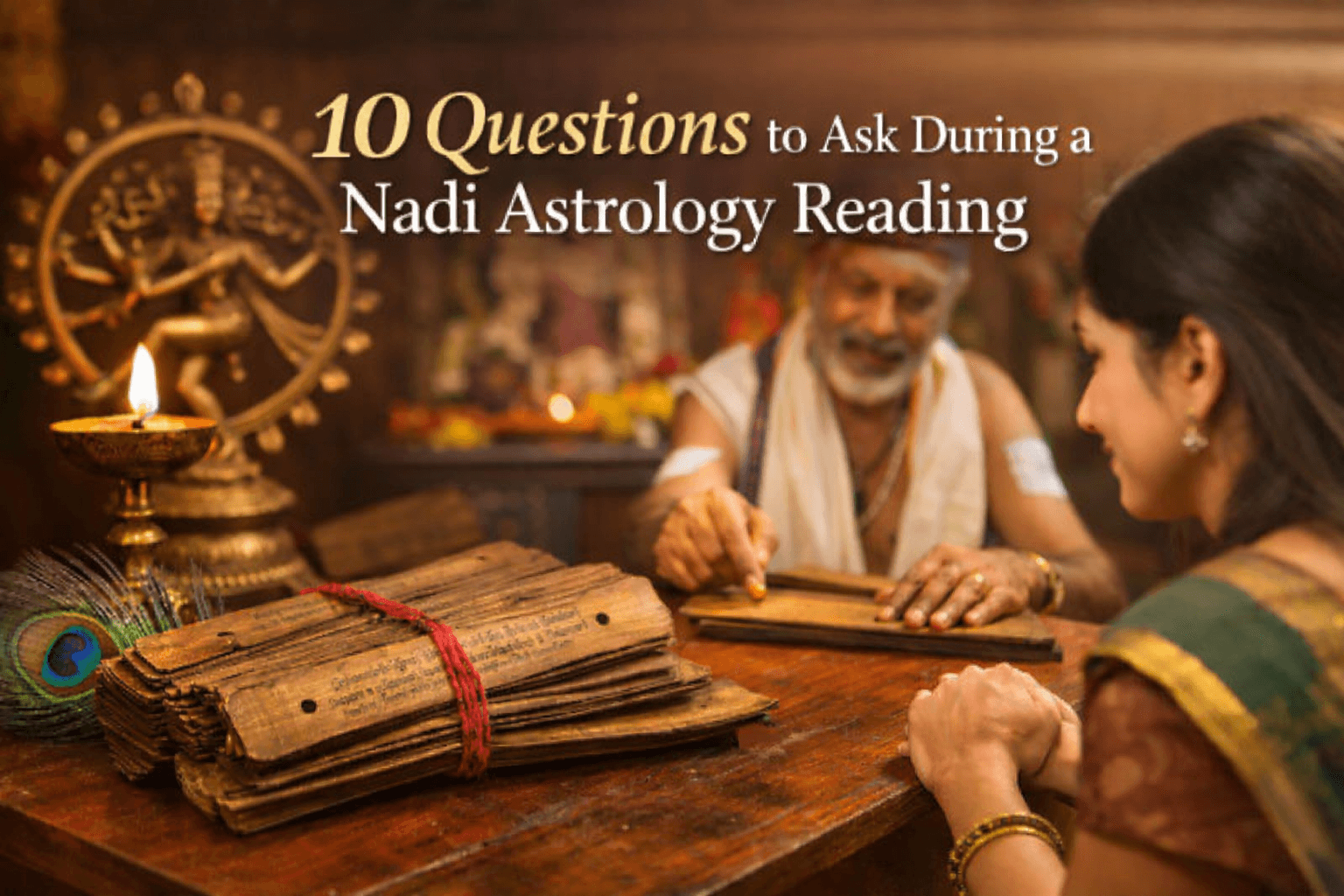
10 Questions You Should Ask During a Nadi Astrology Reading

Visiting a Nadi Astrology center is a unique experience. Many people travel to places like Vaitheeswaran Temple in the hope of understanding their life path through ancient palm-leaf manuscripts known as Olai Chuvadi.

During the reading, the astrologer interprets the information written by sages such as Agastya and explains how it relates to your life.

Most seekers come with genuine curiosity about their future, family, career, and personal growth. Asking the right questions can help you receive more meaningful insights from your Nadi leaf.

Here are 10 questions people commonly ask during a Nadi Astrology reading, expressed from a seeker’s point of view.

1. What does my Nadi leaf say about my future?

This is usually the first question that comes to mind. People are naturally curious to know what the palm leaf reveals about the major events and opportunities in their lives ahead.

2. Will my career move in the right direction?

Many visitors want reassurance about their professional path. Whether someone is starting a new job, planning a business, or considering a career change, they often ask how their future work life will look based on their Nadi leaf.

3. When will good opportunities come into my life?

Seekers are often curious about the timing of positive events. This could relate to career growth, financial progress, or important life milestones.

4. What does my Nadi leaf say about my marriage or relationships?

Questions about marriage are very common. People want to understand the nature of their future partner, the harmony of their relationship, and the right time for marriage.

5. How will my family life unfold?

Many people ask about their future family life — including children, harmony in relationships, and the overall happiness of their household.

6. What are the strengths or talents mentioned in my Nadi leaf?

Nadi astrology often reveals personal strengths or abilities that can help someone succeed. Seekers like to know the qualities that will support them in life.

7. What blessings are written in my Nadi leaf?

People are always curious to know the positive aspects of their destiny — the opportunities, support, and blessings that may come their way.

8. Are there spiritual practices that can help me grow?

Since Nadi astrology has strong spiritual roots, many seekers ask about practices like prayers, temple visits, or acts of charity that can bring peace and positive energy.

9. What guidance do the sages give for my life?

The palm leaves are believed to contain wisdom from ancient sages. Many visitors simply want to know what guidance these sages have offered for living a balanced and meaningful life.

10. How can I make the best use of the opportunities in my life?

Rather than focusing on problems, many seekers ask how they can make the most of the opportunities that lie ahead. This question often brings practical advice from the Nadi reading.

Final Thoughts

A Nadi Astrology reading is not just about hearing predictions. It is about understanding your life story as written in the ancient Olai Chuvadi manuscripts and receiving guidance for your journey ahead.

By asking thoughtful and sincere questions, you can gain deeper clarity about your path and make the most of the wisdom preserved in this ancient tradition.